
Too Good To Go: the real maths of surplus bags (and why we stopped)
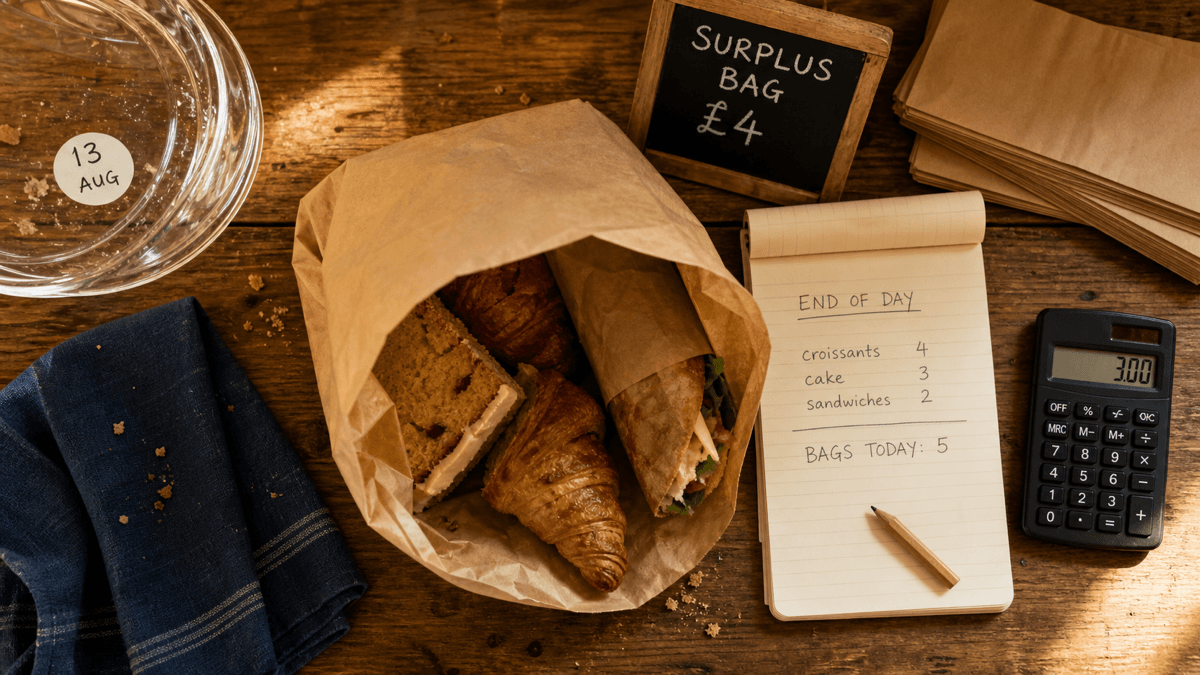
The first time we listed surprise bags at Hunters, they were gone in seconds. Not minutes. Seconds. You put the bags live in the afternoon and by the time you've dried your hands they're sold, every one of them, day after day.
That feels like a win. Honestly, for a while it was one. Money coming back off a tray of bakery that was heading for the bin, no marketing spend, no awkward haggling at the counter.
We stopped anyway. Not because the platform did anything wrong, and not because the maths didn't work. Because of what selling out in seconds every single day was actually telling us.
How surplus apps work, in plain terms
The model is the same across the surplus apps, and it's deliberately simple.
You list a set number of bags each day. The customer doesn't choose what's in them, which is the whole point: it's whatever you have left. You price them at roughly a third of what the contents would have sold for on your counter. Customers buy through the app and collect in a short window near closing.
The platform takes a commission on every bag sold, plus an annual platform fee for being listed. You keep what's left. Fees vary by market and get revised from time to time, so check the current rates directly rather than trusting a number in a blog post.
An illustrative bag
Say a bag holds around £12 of retail value: a couple of pastries, a slice of cake, a sandwich that won't survive the night.
- Retail value of contents: around £12
- Price to the customer: around £4
- Platform commission comes out of that
- You might keep around £3
- If it goes in the bin instead: £0
Three pounds against nothing. Put like that, it looks unarguable, and that framing is exactly why so many cafés sign up in an afternoon and never look at it again.
The catch is buried in the comparison. It only beats zero if the food was genuinely going to be zero.
The genuinely good bits
Let me be fair, because it worked for us and I'd be rewriting history to pretend otherwise.
- Instant demand. Ours sold out within seconds of going live, consistently. You are not building an audience from scratch; the demand is already sitting there with notifications switched on.
- Zero marketing effort. No posts to write, no photos to take, no A-board. You list, it sells.
- You recover something from a sunk cost. The flour, the butter, the labour and the oven time are already spent. Anything above zero is real money back.
- A genuine anti-waste story. Customers like it, and they should. Food that would have been binned gets eaten. That's not greenwash, it's just true.
- New faces through the door. People who'd never been in the café collect a bag and see the place properly for the first time.
If you're sitting on a lot of unsold bakery at close and doing nothing about it, this is unquestionably better than the bin.
The costs that don't appear on the dashboard
Here's the other side. None of these show up in the platform's reporting, which is precisely why they get missed.
Expectation pressure
People paying a few pounds expect a lot for their money. That's human. But it means the bar is set by the best bag they've ever had, not by what you actually had left that day.
A quiet Tuesday where you sold nearly everything is a good trading day, and it's also the day your bag looks thin. A thin bag earns disappointment, and disappointment earns a public rating. You're being scored on your surplus, which is the one part of your operation you're trying to make smaller.
Staff time at closing
Somebody has to assemble those bags at the exact moment your team is cleaning down, cashing up and trying to get out of the door. It's ten or fifteen minutes of the most expensive, most rushed part of the day, plus the handovers at the collection window.
It's not a disaster. It's just never zero, and it's never in the sums.
Cannibalisation
This is the one that really deserves your attention. You are training customers that a bag exists at closing time for a few pounds.
Some of the people picking up a bag at 4pm would otherwise have bought a cake at 3pm at full price. When that happens, you haven't rescued waste, you've discounted a sale you already had. And a discount comes straight off your margin rather than off your cost, which is why a modest-looking discount does far more damage to profit than the percentage suggests. Your ingredients cost exactly the same whether the item leaves at £4.20 or £1.40.
The buyers often aren't regulars, and don't become regulars
Ours were largely bargain hunters. Lovely people, genuinely, and doing nothing wrong: they're collecting value, and the app is a very efficient way to collect value.
But they were mostly not our regulars, and they largely did not become regulars. The "new faces" benefit is real, but you should treat it as a bonus rather than a customer acquisition channel, because the thing that brought them in was the price, and your counter doesn't run at that price.
The subtle one: it takes the pressure off
This is the reason we actually stopped.
When you have a reliable outlet that clears your surplus every single day, the pain of overproducing quietly disappears. Nobody stands at the bin at close feeling sick about it any more. The tray gets bagged, the money comes in, everyone goes home.
And so the over-baking never gets fixed. The waste line stops being a problem and becomes a routine, and a routine you've monetised is a routine nobody questions. That's a comfortable place to be, and it's costing you the difference between £12 of retail value and £3 of recovery, every day, forever.
The ladder: do these in order
Surplus apps aren't wrong. They're just on the wrong rung for most cafés, because they get bolted on before the cheaper work is done. Here's the order that actually makes you money.
1. Measure the waste line and fix production first
You cannot manage what you've never counted. Log what goes unsold for two weeks, by product and by day, before you do anything else. Most operators find the waste concentrated in a handful of lines on two or three predictable days, and tightening end-of-day waste through better production planning fixes more of it than any app will.
Baking two fewer of something is worth far more than selling those two at a third of the price, because the cost never happens in the first place. This is also where knowing the real cost of what's in the bag matters: if you don't know what a tray genuinely costs you, every conversation about waste stays a feeling rather than a number. That's the job CostingBrik does, keeping recipe costs current as supplier prices move.
2. Use the markdown clock on your own counter
Before you hand a platform your surplus, try selling it yourself. A simple, predictable end-of-day markdown on your own counter costs you no commission, keeps the customer relationship, and reaches the people already walking past at 4pm.
The other half of this is deciding what shouldn't be sold at all today: a freezer used properly is a margin tool rather than a graveyard, and some of what you'd bag up is better frozen down and baked off when you actually need it.
3. Then use a surplus app as a controlled overflow valve
Now it earns its place. Once production is tight and your own markdown is running, whatever is still left is genuine surplus, and recovering something from it beats binning it.
Two rules make the difference:
- Cap the daily bag count at a number below your worst days, so it never becomes the plan
- Never let bag numbers become a production target. The moment anyone bakes for the bags, you have built a loss-making product line and given it a schedule
4. If you have your own ordering channel, run your surplus bags there
This is what we do now. Hunters has its own ordering app, so end-of-day surplus bags get listed there instead: no commission to pay, and the reward lands on the customers who already love us rather than on deal chasers passing through.
That's the same argument that makes people look twice at what delivery platform commission really costs a café. Owning the channel means you keep the margin and the customer relationship, and a surplus bag becomes a small perk for regulars rather than a discount broadcast to strangers.
The verdict
Surplus apps are worth using deliberately and risky on autopilot. Used well, they turn a sunk cost into a few pounds and give you a story customers genuinely like. Used lazily, they anaesthetise the problem you should be fixing and quietly train part of your local market to wait until closing.
They're a valve, not a strategy.
And here's the test I'd leave you with, from 17 years of watching this from behind a counter: if your bags sell out in seconds every single day, that isn't a sign it's going brilliantly. It's a sign you're overproducing on schedule.
Fix the production, keep the valve, and cap it. That order round the right way is worth more than any commission rate you'll ever negotiate.
Ed O'Brien has run Hunters Cake Company for 17 years across cafés in Witney, Burford, and a bakery in Carterton, Oxfordshire. He's building Brikly - modular tools that give independent café owners the same data the big chains have, without the big chain price tag.